Tuesday, 3 October 2017

Kendall + Pepsi = Fail

Pepsi's recent campaign which featured across Facebook, Instagram and normal advertising channels showed Kendall Jenner subdue protest tensions by offering a police officer a can of Pepsi. 


Pepsi sought to depict the brand as a cultural unifying force but received a lot of backlash in the media and many people criticized the messaging strategy present in the ad. 

Twitter users were quick to point out that Pepsi's ad appropriated imagery from social justice movements like Black Lives Matter without concretely outlining its own real-world issues to tackle, making the entire effort look cynical. 

The tone-deafness here was attributed by some to the ad being made by an in-house shop which spurred larger discussions about the lack of perspective in-house creative work can produce and the value of third-party agencies. 

Brand messaging that gets political without looking to make a social good investment or fitting it into the larger brand story is likely to be rejected. A recent report from industry group 4A's found that 58% of consumers don’t want politics in their marketing at all, and widespread criticism of a push like Pepsi's speaks to that skepticism and the fine balance that must be struck.

Speaking to the Heart

Sometimes great advertising goes beyond branding and speaks to the heart of people’s needs, fears, hopes and dreams. 

Procter & Gamble’s “My Black Is Beautiful” campaign showed that if a advertisement touches the viewers heart, they are more likely to talk about it and create conversation on social media.

The two-minute #TalkAboutBias commercial called on consumers to discuss and end racial bias. Throughout the emotional clip, we see African-American mothers teaching their children to believe in themselves despite prejudice.


P&G’s #TalkAboutBias spot has garnered nearly 1 million views, 16,000 reactions, 19,000 shares and 4,000 comments since its Facebook debut in late July. On YouTube, the commercial spawned a number of reaction videos, and the #TalkAboutBias hashtag trended on Twitter.

That’s one well-executed campaign. But many marketers become so consumed with the functionality of social platforms that they forget that social is simply an enabler. Analytics features help them share in targeted, automated ways. However, social tools are only as effective as the content you create. 

P&G’s campaign works because it speaks to an ongoing concern in American society by empathizing with the afflicted and reaching for viewers’ heartstrings. In today’s data-driven marketing environment, social advertisers often become so fixated on the numbers and analytics that they forget they’re talking to fellow humans. However, emotions drive 80 percent of people’s decisions. 

Stats alone will not help brands reach their audiences in meaningful ways. In fact, the combination of people-centric messaging with consumer analytics has the potential to drive a new era of emotionally resonant, high-performing ads.

Monday, 4 September 2017

A Photo a Day...

GoPro got social media followers and owners of their action cameras involved by creating an interactive social media campaign. 
GoPro photo of the day campaign
Each day, they selected a photo submitted by a GoPro user to share across their social media networks. 
In addition to giving winners exposure to their 9.4 million Facebook fans, 8.2 million Instagram followers, 1.5 million Twitter followers, the lucky content creators also received cash rewards. 
GoPro has dedicated up to $5 million per year to give to those who submit photos, videos, and clips taken with their products. 
This campaign is a great example of community involvement; getting users involved by motivating them with exposure and prizes. 
It makes use of a great model for exposure. It is important to encourage users to share photos, videos, and stories using the product or service which gets the brand name out there. Users can also be enticed with cash prizes, free giveaways, promotions, or even re-posts.

We're all Ears

How could anyone possibly scroll past something as cute as this little button in Mickey ears?
screenshot-2016-12-29-at-12-18-06-pm
Disney and Make-A-Wish partnered to invite users to share photos of themselves in Mickey ears on Twitter and Instagram. For every post, Disney donated $5 to the Make-A-Wish Foundation.

#ShareYourEars ending up nabbing one of the coveted trending spots on Facebook and Disney pushed their original commitment of $1 million to $2 million based off of the flood of posts. 

As far as engaging social media campaigns go, you can’t beat this one.

Bonus: the cute factor on the photos really helped the shares. 

Tuesday, 22 August 2017

Silent yet Tasty

A couple of weeks ago we took at look at a campaign that hid a secret message within the audio of their Facebook video to see who was really listening.

But one company has essentially taken the entire concept of a silent video and branded it...

You know all of those silent, quick recipe videos shot from above that you see all over your Facebook feed? Yeah, Buzzfeed started those.


In under a minute, users see a recipe from start to finish with subtitles over sound - perfect for Facebook’s auto-play feature. 

I mean who in their right mind could ever just scroll past a recipe for Taco Cheese Cups?....

Tasty’s Facebook page now has over 88 million likes and 3.7 million subscribers on YouTube. The brand has spawned spin offs like Tasty Junior, Tasty Happy Hour and Nifty (a DIY video series), not to mention all the parodies and copy cats.

The entire layout of the videos and the thought process behind them has changed the way we ingest visual media and is tailor made for Facebook. 

What's really genius about Tasty is the way they sensed a trend and a change in media consumption before there even was one.

Their videos have a very large market reach across both Facebook and YouTube and are extremely 'shareable' with many people tagging their friends or family in the deliciousness. 

Sunday, 20 August 2017

Tribute or Insult

Now, to our first examples of where companies have gotten it very wrong when posting content on social media.

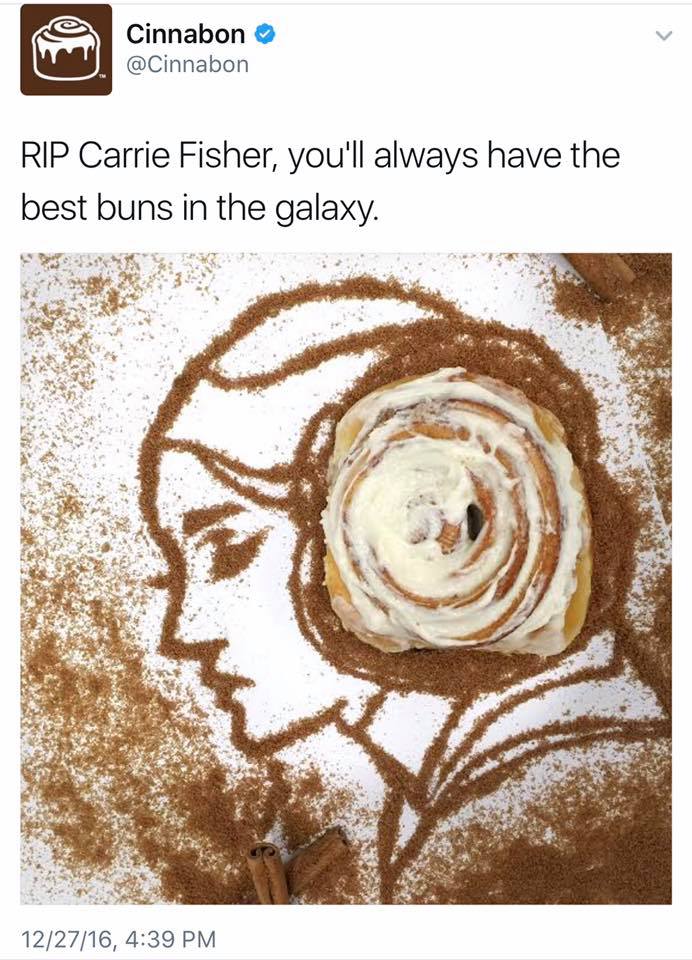
Shortly after the passing of actress and author Carrie Fisher in December 2016, tributes flooded in from around the world on social media to mourn the passing of the "Star Wars" icon. However, for one company, its tribute was not to everyone's taste.

U.S. baked goods company Cinnabon issued an apology on Twitter after the backlash it received from tweeting out a tribute to Carrie Fisher, featuring an image of Princess Leia made out of cinnamon and a cinnamon roll.


Many critics said that it is beyond tacky and many felt that Cinnabon had utilised the death of a celebrity to hawk their product. 
However, Cinnabon wasn't the the only company in 2016 whose tribute about the passing of a beloved celebrity had sparked criticism.

When David Bowie died in January, shoe manufacturer Crocs drew fire after it posted an image of a white pair of Crocs with Bowie's Aladdin Sane flash logo.


Image result for crocs david bowie


Meanwhile Cheerios faced backlash after posting an image saying "Rest in Peace" with a single Cheerio on the 'I' on a purple background, shortly after musician Prince passed away.


Image result for cheerios Prince post


These three examples social media marketing blunders should be taken as shining examples of the dangers that relate to poorly thought through Twitter content.

Although very low cost and extremely easy to do, Twitter has such a wide reach that it's integral that the brand's reputation is not defamed as a result of Tweets like these.


Source: https://www.cnbc.com/2016/12/28/cinnabon-deletes-and-apologizes-for-its-carrie-fisher-tribute-after-twitter-backlash.html

Put Some Windex on It

We are all very familiar with the phrase from a certain movie about a Big, Fat Greek Wedding...

 my sets GIF

Perhaps Toula's Dad paved the way for seeing the distinctive blue cleaning product in a hilariously different light. But Windex have launched a new marketing campaign in hopes of making the product emotionally compelling by focusing not on the product, but on the silent service that it provides.

Windex's "Give Life a Sparkle" campaign was produced by advertising company Energy BBDO and launched via YouTube. The three-minute film titled "The Story of Lucy" recounts that old tale about a Dad witnessing the miracle of birth and watching his daughter grow up.


The brand's role is downplayed, focusing instead on the father's face as he experience the joys and quiet heartbreaks of watching his child become an adult. At the ads beginning, the Father place his hand on the flawless glass of the hospital nursery thus downplaying the brand's impact.

The conclusion of the story shows his daughter and her partner present their own baby to the Father through yet another hospital nursery window as he raises his hand to the spotless glass which drives the recall home.

The ad concludes by telling us that "What's between us, connects us." The results of that insight certainly shine through.

The heart-string pulling rendition marks a departure from the tired product-attribute focus that plagues Windex's advertising sector.

It's a refreshing example of a social media advertising tactic that captures the viewers attention by utilizing emotional appeal rather than a focus on its practical attributes. YouTube is also a great choice of platform due to it's easy sharing capabilities and vast market reach.

Source: https://www.youtube.com/watch?v=kUFPGYVhmSs